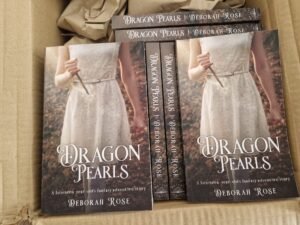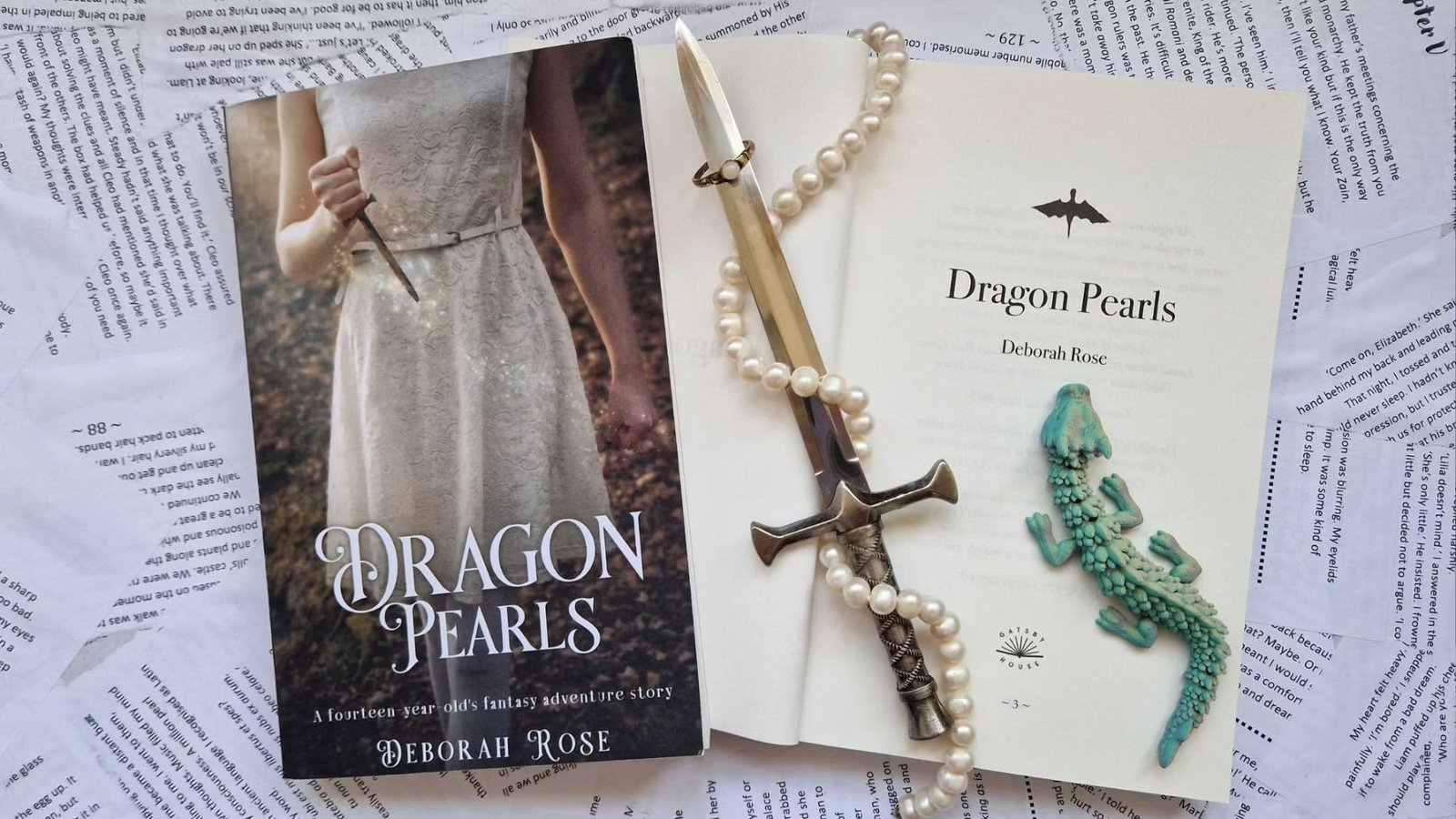
My name is Deborah Rose and I wrote Dragon Pearls at fourteen. Ten years later, I’m a professional editor and I just released it through Gatsby House, earning #1 New Release in YA Survival Stories and #10 on the YA Sword & Sorcery Fantasy Amazon bestseller list. When I set out to edit my novel back in January, I intended to do a simple proofread and silently replace the file—maybe update the cover—then bury it on the last page of my website. But when I reread the words that fourteen-year-old me had written, I couldn’t leave it there.
I reconnected with the characters that I’d spent hours shut up in my bedroom creating and saw Dragon Pearls as the story that shaped my teenage years. The one that made me dream of making a living as a writer. Teenage me had so many dreams and aspirations and they were dashed when COVID-19 sent the whole world into lockdown shortly after the release of my early editions. Rereading it, I realised that I knew so much more about bringing a book into the world. I could do my debut novel justice.
Twenty-four-year-old me has a First Class Creative Writing BA (Hons), and five years of industry experience in writing, editing, and publishing. At fourteen, I didn’t have any of that. So here I want to talk about some of the writing “rules” that 14 year-old me “disobeyed” and why twenty-four-year-old me decided to keep them.
1. My character faints a lot.
One odd pattern that I noticed as I edited my book is that there are several points in the story where my main character, Esther (later called Elizabeth), faints or comes close to fainting and the next scene or chapter opens with her waking up. This is typically considered a cliché way of ending and starting scenes and it’s something that as an adult I’ve learned not to do—or at least to limit. However, I found the pattern fascinating because I had a recent diagnosis of POTS (Postural Orthostatic Tachycardia Syndrome), meaning my body struggles to regulate blood flow and heart rate when moving from sitting to standing, causing me to experience fainting or near-fainting. Now the thing about POTS is that it typically emerges in adolescence. At the age of fourteen, I probably had it—just undiagnosed. Writing a fictional story gave me the chance to invent a cause and so it became that my character gets dizzy when she overexerts herself while using magic. The “rule” that I broke was actually an autobiographical aspect of the novel and a part of what made it so true to the person I was at the time of writing. That’s why I decided not to edit it out.
2. Some named characters only appear for a single scene.
This was another noticeable “rule” that 14 year-old me broke more than once. Several named characters played an important role in the story but only appeared for a single scene. In the writing world, this is typically considered bad practice because why waste time establishing a minor person when there are more important things going on? And yet I didn’t edit it out. Now one of the reasons this happened originally is that, at fourteen, I spent a lot of time with these characters imagining them, world-building… To me, these people were so much more than they appeared on paper. They had full lives and families and backstories. They were complex and well-rounded, and yet the reader only saw a small fraction of that. I chose not to take out their names or reduce their scenes because those characters were so important to my younger self, and it felt disrespectful to her to remove them. And who knows, perhaps I can bring them back in book two?
3. Named characters die. Not (really) a spoiler.
This rule break is similar to the one above, but my reasons for keeping it in are different. The named characters who die contribute to one specific character’s arc and they’re important to the overall dynamic of the story. I made the choice to leave them alone partially because of how important it was to me at the age that I wrote the book, but mainly because I would have had to have made more substantial rewrites if I hadn’t included it. The final draft is much stronger and more authentic as a result of leaving them alone.
I think I can conclude that all of the changes I made or didn’t make were because I didn’t want this to be a rewrite of my book. I wanted it to be an edit. I wanted to preserve the demonstration of what fourteen-year-old me achieved and not prove what I’m capable of today. Dragon Pearls is important to me because of the characters and the story, yes, but it’s also important to me because it was the story that I created at a very meaningful time in my life. So I couldn’t be happier with where it’s landed, regardless of the fact that it breaks the “rules” that have been ingrained into me through years of study and practice. Dragon Pearls is a time capsule of who I was before I was officially taught. I’m proud to say that I’ve received feedback that it’s inspired other teenagers to write their stories and I hope, as I continue to market my novel, that it will reach many more.
Visit Deborah Rose Editorial website
Follow Deborah on Instagram
Deborah is a Teesdale based author, a friend of Teesdale Writers and the editor of a few Teesdale authors books.